What time is it??

Showing posts with label rock. Show all posts

Thursday, July 8, 2010

A Grain of Sand Picture Gallery


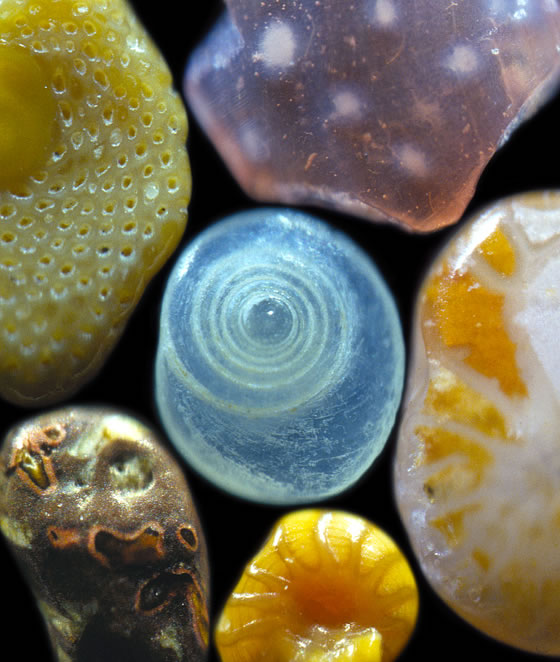
The tip of a spiral shell has broken off and become a grain of sand. It is opalescent from the repeated tumbling action of the surf. Surrounding the shell fragment are five other sand grains, from top middle clockwise, (1) a pink shell fragment, (2) a foram, (3) a microscopic shell, (4) a volcanic melt, and (5) a bit of coral. Image Copyright © 2008 Dr. Gary Greenberg, All Rights Reserved.
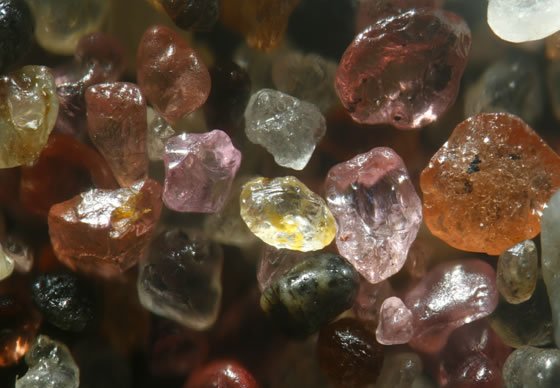

Sand from Skeleton Beach in Namibia contains rounded and polished pink-and-red garnet. Image Copyright © 2008 Dr. Gary Greenberg, All Rights Reserved.
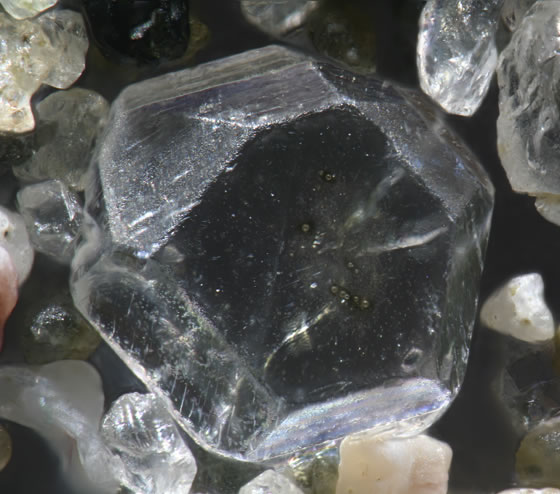


Sand from Zushi Beach, Japan, contains what looks like a sapphire crystal. The crystal is larger than the surrounding grains and has survived eroding because of its hardness and quality. Image Copyright © 2008 Dr. Gary Greenberg, All Rights Reserved.
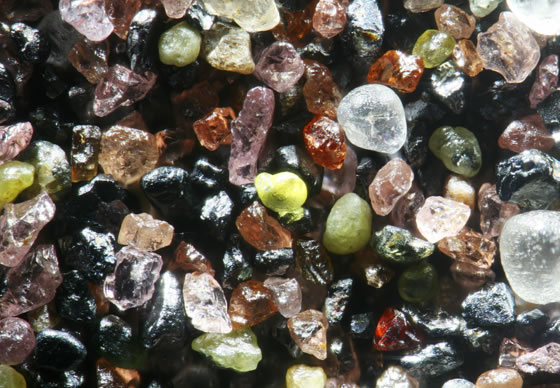


The glacially deposited sands around Lake Winnibigoshish, Minnesota, contain abundant sediments from the igneous and metamorphic minerals of the Lake Superior basin. A sample includes pink garnets, green epidote, iron-rich red agates, black magnetite, and hematite. Image Copyright © 2008 Dr. Gary Greenberg, All Rights Reserved.

Friday, April 2, 2010

Sedimentary Rocks

Sedimentary rocks are formed by the accumulation of sediments. There are three basic types of sedimentary rocks: 1) clastic sedimentary rocks such as breccia, conglomerate, sandstone and shale, that are formed from mechanical weathering debris; 2) chemical sedimentary rocks such as rock salt and some limestones, that form when dissolved materials precipitate from solution; and, 3)organic sedimentary rocks such as coal and some limestones which form from the accumulation of plant or animal debris. Pictures and brief descriptions of some common sedimentary rock types are shown below.

Breccia

Breccia is a clastic sedimentary rock that is composed of large (over two millimeter diameter) angular fragments. The spaces between the large fragments can be filled with a matrix of smaller particles or a mineral cement which binds the rock together. The specimen shown above is about two inches (five centimeters) across.

Chert

Chert is a microcrystalline or cryptocrystalline sedimentary rock material composed of silicon dioxide (SiO2). It occurs as nodules and concretionary masses and less frequently as a layered deposit. It breaks with a conchoidal fracture, often producing very sharp edges. Early people took advantage of how chert breaks and used it to fashion cutting tools and weapons. The specimen shown above is about two inches (five centimeters) across.

Coal

Coal is an organic sedimentary rock that forms mainly from plant debris. The plant debris usually accumulates in a swamp environment. Coal is combustible and is often mined for use as a fuel. The specimen shown above is about two inches (five centimeters) across.

Conglomerate

Conglomerate is a clastic sedimentary rock that contains large (greater then two millimeters in diameter) rounded particles. The space between the pebbles is generally filled with smaller particles and/or a chemical cement that binds the rock together. The specimen shown above is about two inches (five centimeters) across.

Iron Ore

Iron Ore is a chemical sedimentary rock that forms when iron and oxygen (and sometimes other substances) combine in solution and deposit as a sediment. Hematite (shown above) is the most common sedimentary iron ore mineral. The specimen shown above is about two inches (five centimeters) across.

Limestone

Limestone is a rock that is composed primarily of calcium carbonate. It can form organically from the accumulation of shell, coral, algal and fecal debris. It can also form chemically from the precipitation of calcium carbonate from lake or ocean water. Limestone is used in many ways. Some of the most common are: production of cement, crushed stone and acid neutralization. The specimen shown above is about two inches (five centimeters) across.

Rock Salt

Rock Salt is a chemical sedimentary rock that forms from the evaporation of ocean or saline lake waters. It is also known by the mineral name "halite". It is rarely found at Earth's surface, except in areas of very arid climate. It is often mined for use in the chemical industry or for use as a winter highway treatment. Some halite is processed for use as a seasoning for food. The specimen shown above is about two inches (five centimeters) across.

Sandstone

Sandstone is a clastic sedimentary rock made up mainly of sand-size (1/16 to 2 millimeter diameter) weathering debris. Environments where large amounts of sand can accumulate include beaches, deserts, flood plains and deltas. The specimen shown above is about two inches (five centimeters) across.

Shale

Shale is a clastic sedimentary rock that is made up of clay-size (less then 1/256 millimeter in diameter) weathering debris. It typically breaks into thin flat pieces. The specimen shown above is about two inches (five centimeters) across.

Siltstone

Sedimentary Rocks


Picture Gallery of the Most Common Rock Types


Sedimentary rocks are formed by the accumulation of sediments. There are three basic types of sedimentary rocks: 1) clastic sedimentary rocks such as breccia, conglomerate, sandstone and shale, that are formed from mechanical weathering debris; 2) chemical sedimentary rocks such as rock salt and some limestones, that form when dissolved materials precipitate from solution; and, 3)organic sedimentary rocks such as coal and some limestones which form from the accumulation of plant or animal debris. Pictures and brief descriptions of some common sedimentary rock types are shown below.

Sedimentary Rock Types Menu

Breccia
Breccia
Chert
Chert
Anthracite Coal
Coal
Conglomerate
Conglomerate
Hematite Iron Ore
Iron Ore
Limestone
Limestone
Halite Rock Salt
Rock Salt
Sandstone
Sandstone
Shale
Shale
Siltstone
Siltstone

Breccia
breccia
Breccia is a clastic sedimentary rock that is composed of large (over two millimeter diameter) angular fragments. The spaces between the large fragments can be filled with a matrix of smaller particles or a mineral cement which binds the rock together. The specimen shown above is about two inches (five centimeters) across.
Return to Top

teaching

Chert
chert
Chert is a microcrystalline or cryptocrystalline sedimentary rock material composed of silicon dioxide (SiO2). It occurs as nodules and concretionary masses and less frequently as a layered deposit. It breaks with a conchoidal fracture, often producing very sharp edges. Early people took advantage of how chert breaks and used it to fashion cutting tools and weapons. The specimen shown above is about two inches (five centimeters) across.
Return to Top


Coal
coal
Coal is an organic sedimentary rock that forms mainly from plant debris. The plant debris usually accumulates in a swamp environment. Coal is combustible and is often mined for use as a fuel. The specimen shown above is about two inches (five centimeters) across.
Return to Top


Conglomerate
conglomerate
Conglomerate is a clastic sedimentary rock that contains large (greater then two millimeters in diameter) rounded particles. The space between the pebbles is generally filled with smaller particles and/or a chemical cement that binds the rock together. The specimen shown above is about two inches (five centimeters) across.
Return to Top


Iron Ore
iron ore - hematite
Iron Ore is a chemical sedimentary rock that forms when iron and oxygen (and sometimes other substances) combine in solution and deposit as a sediment. Hematite (shown above) is the most common sedimentary iron ore mineral. The specimen shown above is about two inches (five centimeters) across.
Return to Top


Limestone
limestone
Limestone is a rock that is composed primarily of calcium carbonate. It can form organically from the accumulation of shell, coral, algal and fecal debris. It can also form chemically from the precipitation of calcium carbonate from lake or ocean water. Limestone is used in many ways. Some of the most common are: production of cement, crushed stone and acid neutralization. The specimen shown above is about two inches (five centimeters) across.
Return to Top


Rock Salt
rock salt
Rock Salt is a chemical sedimentary rock that forms from the evaporation of ocean or saline lake waters. It is also known by the mineral name "halite". It is rarely found at Earth's surface, except in areas of very arid climate. It is often mined for use in the chemical industry or for use as a winter highway treatment. Some halite is processed for use as a seasoning for food. The specimen shown above is about two inches (five centimeters) across.
Return to Top


Sandstone
sandstone
Sandstone is a clastic sedimentary rock made up mainly of sand-size (1/16 to 2 millimeter diameter) weathering debris. Environments where large amounts of sand can accumulate include beaches, deserts, flood plains and deltas. The specimen shown above is about two inches (five centimeters) across.
Return to Top


Shale
shale
Shale is a clastic sedimentary rock that is made up of clay-size (less then 1/256 millimeter in diameter) weathering debris. It typically breaks into thin flat pieces. The specimen shown above is about two inches (five centimeters) across.
Return to Top


Siltstone

Siltstone is a clastic sedimentary rock that forms from silt-size (between 1/256 and 1/16 millimeter diameter) weathering debris. The specimen shown above is about two inches (five centimeters) across.

Sunday, March 28, 2010

Metamorphic Rocks

Metamorphic rocks have been modified by heat, pressure and chemical process usually while buried deep below Earth's surface. Exposure to these extreme conditions has altered the mineralogy, texture and chemical composition of the rocks. There are two basic types of metamorphic rocks: 1) foliated metamorphic rocks such as gneiss, phyllite, schist and slate which have a layered or banded appearance that is produced by exposure to heat and directed pressure; and, 2) non-foliated metamorphic rocks such as marble and quartzite which do not have a layered or banded appearance. Pictures and brief descriptions of some common types of metamorphic rocks are provided below.
there's the picture some metamorphic rock:

Amphibolite

Amphibolite is a non-foliated metamorphic rock that forms through recrystallization under conditions of high viscosity and directed pressure. It is composed primarily of amphibole and plagioclase, usually with very little quartz. The specimen shown above is about two inches (five centimeters) across.

Gneiss

Gneiss is foliated metamorphic rock that has a banded appearance and is made up of granular mineral grains. It typically contains abundant quartz or feldspar minerals. The specimen shown above is about two inches (five centimeters) across.

Hornfels

Hornfels is a fine-grained nonfoliated metamorphic rock with no specific composition. It is produced by contact metamorphism. Hornfels is a rock that was "baked" while near a heat source such as a magma chamber, sill or dike. The specimen shown above is about two inches (five centimeters) across.

Marble

Marble is a non-foliated metamorphic rock that is produced from the metamorphism of limestone. It is composed primarily of calcium carbonate. The specimen shown above is about two inches (five centimeters) across.

Phyllite

Phyllite is a foliate metamorphic rock that is made up mainly of very fine-grained mica. The surface of phyllite is typically lustrous and sometimes wrinkled. It is intermediate in grade between slate and schist. The specimen shown above is about two inches (five centimeters across).

Quartzite

Quartzite is a non-foliated metamorphic rock that is produced by the metamorphism of sandstone. It is composed primarily of quartz. The specimen above is about two inches (five centimeters) across.

Schist (chlorite)

Schist is metamorphic rock with well developed foliation. It often contains significant amounts of mica which allow the rock to split into thin pieces. It is a rock of intermediate metamorphic grade between phyllite and gneiss. The specimen shown above is a "chlorite schist" because it contains a significant amount of chlorite. It is about two inches (five centimeters) across.

Schist (garnet)

Schist is metamorphic rock with well developed foliation. It often contains significant amounts of mica which allow the rock to split into thin pieces. It is a rock of intermediate metamorphic grade between phyllite and gneiss. The specimen shown above is a "garnet schist" because it contains a significant amount of garnet. The small crystals visible in the rock are small red garnets. It is about two inches (five centimeters) across.

Slate

Slate is a foliated metamorphic rock that is formed through the metamorphism of shale. It is a low grade metamorphic rock that splits into thin pieces. The specimen shown above is about two inches (five centimeters) across.

Tuesday, March 16, 2010

The Sliding Rocks of Racetrack Playa


One of the most interesting mysteries of Death Valley National Park is the sliding rocks at Racetrack Playa (a playa is a dry lake bed). These rocks can be found on the floor of the playa with long trails behind them. Somehow these rocks slide across the playa, cutting a furrow in the sediment as they move.

Some of these rocks weigh several hundred pounds. That makes the question: "How do they move?" a very challenging one.

The truth: No one knows for sure exactly how these rocks move - although a few people have come up with some pretty good explanations. The reason why their movement remains a mystery: No one has ever seen them in motion!

Let's learn how they are thought to move....


About Racetrack Playa


Racetrack playa is lake bed that is almost perfectly flat and almost always dry. It is about 4 kilometers long (2.5 miles - north to south) and about 2 kilometers wide (1.25 miles - east to west). The surface is covered with mudcracks and the sediment is made up mainly of silt and clay.

The climate in this area is arid. It rains just a couple of inches per year. However, when it rains, the steep mountains which surround Racetrack Playa produce a large amount of runoff that converts the playa floor into a broad shallow lake. When wet, the surface of the playa is transformed into a very soft and very slippery mud.

Are They Moved by People or Animals?

The shape of trails behind the rocks suggest that they move during times when the floor of Racetrack Playa is covered with a very soft mud. A lack of disturbed mud around the rock trails eliminates the possibility of a human or animal pushing or assisting the motion of the rocks.


Are They Moved by Wind?


This is the favorite explanation. The prevailing winds that blow across Racetrack Playa travel from southwest to northeast. Most of the rock trails are parallel to this direction. This is strong evidence that wind is the prime mover or at least involved with the motion of the rocks.

Strong wind gusts are thought to nudge the rocks into motion. Once the rock begins to move a wind of much lower velocity can keep the rock in motion as it slides across the soft and very slippery mud. Curves in the rock trails are explained by shifts in wind direction or in how the wind interacts with an irregularly shaped rock.


Are They Moved by Ice?


A few people have reported seeing Racetrack Playa covered by a thin layer of ice. One idea is that water freezes around the rocks and then wind, blowing across the top of the ice, drags the ice sheet with its embedded rocks across the surface of the playa.

Some researchers have found highly congruent trails on multiple rocks that strongly support this movement theory. However, the transport of a large ice sheet might be expected to mark the playa surface in other ways - these marks have not been found.

Other researchers experimented with stakes that would be disturbed by ice sheets. The rocks moved without disturbing the stakes. The evidence for ice-sheet transport is not consistent.


Wind is the Favored Mover!


All of the best explanations involve wind as the energy source behind the movement of the rocks. The question remains is do they slide while encased in an ice sheet or do they simply side over the surface of the mud? Perhaps each of these methods is responsible for some rock movement?

Perhaps this story will remain more interesting if the real answer is never discovered!


Photos of Sliding Rocks Below!


Movement of a large rock across a barren surface is almost impossible to believe. However, good photographs can serve as evidence for those who can not travel to Death Valley National Park. Thanks to Steve Geer, Stephan Hoerold, Skye Bajoul, sartriano, John Alcorn and Mike Nortan for the great images used here.


A sliding rock that has left a long track across the surface of Racetrack Playa. Some tracks are hundreds of feet long! (See below for several more sliding rock photos.) © iStockphoto / Steve Geer


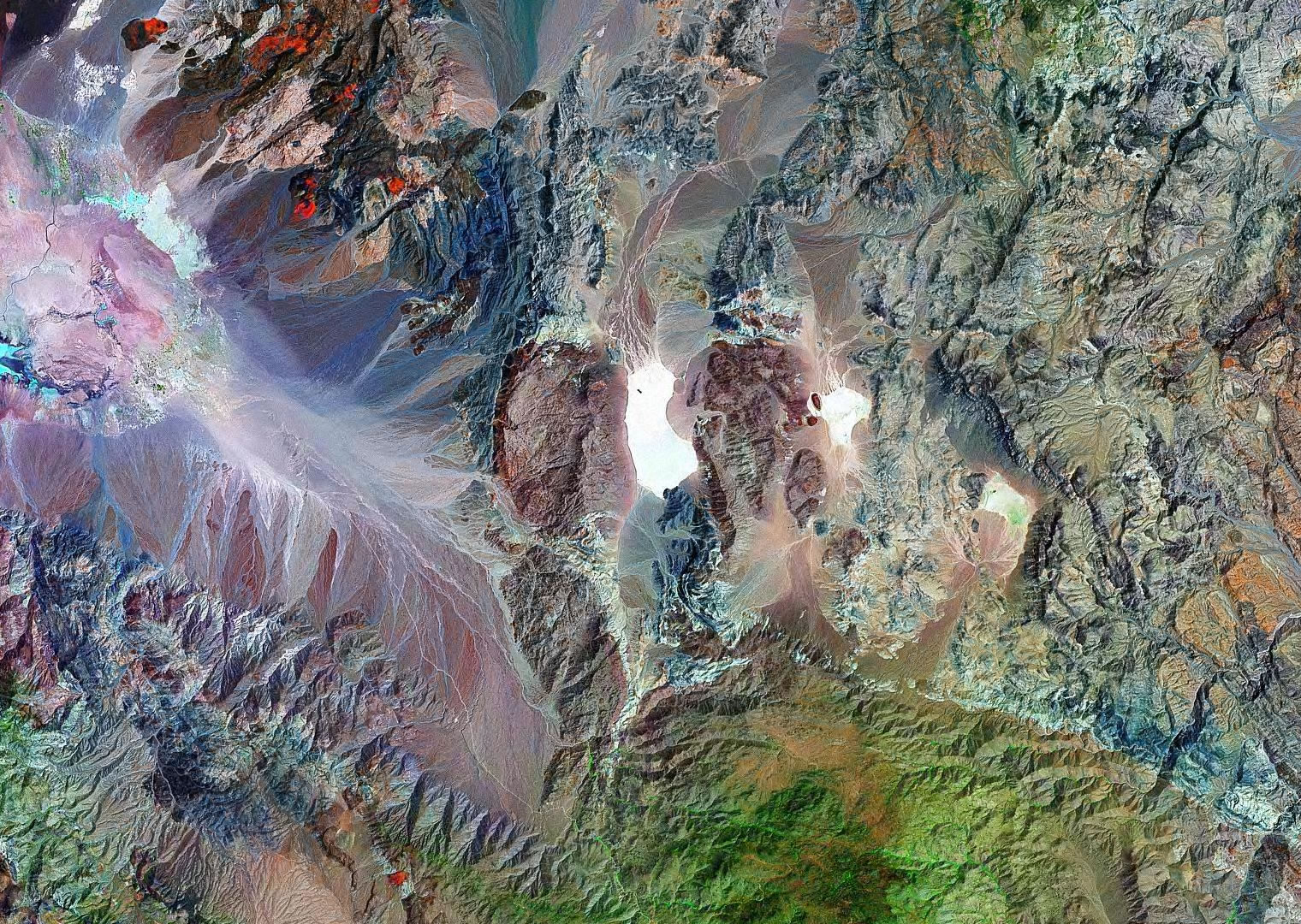
Landsat image of Racetrack Playa. It is the flat white area in the center of the image.
(click for more detail)


Rocks of many sizes and shapes leave tracks across Racetrack Playa.
© iStockphoto / Stephan Hoerold


Closer view of the sliding rock in the top image on this page.
© iStockphoto / Skye Bajoul


Lots of sliding rocks and trails on Racetrack Playa.
© iStockphoto / Stephan Hoerold


undefined
Rocks of many shapes leave trails across Racetrack Playa.
© iStockphoto / sartriano


undefined
Rocks of many shapes leave trails across Racetrack Playa.
© iStockphoto / John Alcorn


undefined