What time is it??

Showing posts with label articles. Show all posts

Wednesday, May 5, 2010

The causes of tsunami

What causes a tsunami?... A tsunami is a large ocean wave that is caused by sudden motion on the ocean floor. This sudden motion could be an earthquake, a powerful volcanic eruption, or an underwater landslide. The impact of a large meteorite could also cause a tsunami. Tsunamis travel across the open ocean at great speeds and build into large deadly waves in the shallow water of a shoreline.

Subduction Zones are Potential Tsunami Locations

Most tsunamis are caused by earthquakes generated in a subduction zone, an area where an oceanic plate is being forced down into the mantle by plate tectonic forces. The friction between the subducting plate and the overriding plate is enormous. This friction prevents a slow and steady rate of subduction and instead the two plates become "stuck".


Image by USGS


Accumulated Seismic Energy

As the stuck plate continues to descend into the mantle the motion causes a slow distortion of the overriding plage. The result is an accumulation of energy very similar to the energy stored in a compressed spring. Energy can accumulate in the overriding plate over a long period of time - decades or even centuries.


Image by USGS


Earthquake Causes Tsunami

Energy accumulates in the overriding plate until it exceeds the frictional forces between the two stuck plates. When this happens, the overriding plate snaps back into an unrestrained position. This sudden motion is the cause of the tsunami - because it gives an enormous shove to the overlying water. At the same time, inland areas of the overriding plate are suddenly lowered.


Image by USGS


Tsunami Races Away From the Epicenter

The moving wave begins travelling out from where the earthquake has occurred. Some of the water travels out and across the ocean basin, and, at the same time, water rushes landward to flood the recently lowered shoreline.


Image by USGS


Tsunamis Travel Rapidly Across Ocean Basis

Tsunamis travel swiftly across the open ocean. The map below shows how a tsunami produced by an earthquake along the coast of Chile in 1960 traveled across the Pacific Ocean, reaching Hawaii in about 15 hours and Japan in less than 24 hours.


Image by USGS


Tsunami "Wave Train"

Many people have the mistaken belief that tsunamis are single waves. They are not. Instead tsunamis are "wave trains" consisting of multiple waves. The chart below is a tidal gauge record from Onagawa, Japan beginning at the time of the 1960 Chile earthquake. Time is plotted along the horizontal axis and water level is plotted on the vertical axis. Note the normal rise and fall of the ocean surface, caused by tides, during the early part of this record. Then recorded are a few waves a little larger than normal followed by several much larger waves. In many tsunami events the shoreline is pounded by repeated large waves.


Image by USGS

The material above describes how tsunamis are generated and how they travel rapidly across an ocean basin. For more detailed information on this topic the following websites are recommended.

Wednesday, November 11, 2009

What is Geyser?

A geyser is a vent in Earth's surface that periodically ejects a column of hot water and steam. Even a small geyser is an amazing phenomenon; however some geysers have eruptions that blast thousands of gallons of boiling hot water up to a few hundred feet in the air.

Old Faithful is the world's best known geyser. It is located in Yellowstone National Park (USA). Old Faithful erupts every 60 to 90 minutes and blasts a few thousand gallons of boiling hot water between 100 and 200 feet into the air.


Conditions Required for a Geyser


Geysers are extremely rare features. They occur only where there is a coincidence of unusual conditions. Worldwide there are only about 1000 geysers and most of those are located in Yellowstone National Park (USA).


Conditions Required for Geysers
1) hot rocks below
2) an ample ground water source
3) a subsurface water reservoir
4) fissures to deliver water to the surface


Where are Geysers Found?


Most of the world's geysers occur in just five countries: 1) the United States, 2) Russia, 3) Chile, 4) New Zealand and 5) Iceland. All of these locations are where there is geologically recent volcanic activity and a source of hot rock below.


Countries With Many Active Geysers
1) United States - Yellowstone National Park
2) Russia - Dolina Geiserov
3) Chile - El Tatio
4) New Zealand - Taupo Volcanic Zone
5) Iceland - Many locations


How Often Do Geysers Erupt?


Most geysers erupt irregularly and infrequently. However, a few are known for regular eruptions. The most famous, named "Old Faithful" in recognition of its regular eruptions, is located in Yellowstone National Park (USA) and erupts about every 60 to 90 minutes. More details on the eruption intervals of Yellowstone geysers is given in the table below.


Old Faithful is Getting Slower
Research done at the United States Geological Survey suggests that long-term drought conditions in the Yellowstone area have lenghtened the time interval between Old Faithful's eruptions. The delay is thought to be caused by a smaller water supply.


Yellowstone Geysers
Eruption Intervals, Duration, Heights
LocationAverage IntervalDurationHeight (ft)
Old Faithful
65 or 92 min
1.5-5 min
106-184
Artemisia
irregular
5-25 sec
30
Aurum
2-4 hours
70 sec
20
Baby Daisy
35-55 min
3 min
25
Beehive
12-18 hours
5 min
150+
"Boardwalk"
irregular
5-10 min
20
Castle
12.5 hours
15-20 min
75
Daisy
2.5 hours
3.5 min
75
Depression
5-9 hours
6 min
10
Echinus
irregular
3-5 min
30+
Fan & Mortar
6-10 days?
45 min
100+
Fountain
5.5 hours
9 min
78
Giant
last eruption 12/24/03
1 hour
200+
Giantess
last eruption 4/21/04
4-48 hours
150+
Grand
8.5 hours
8-12 min
160+
Great Fountain
12.5 hours
45 min
70-200+
Lion - initial to intitial
about 8 hours
1-7 min
60
Lion - within series
about 90 min
3-5 min
30
Little Cub
about 55 min
10 min
5
Plate
3.5-4 min
4 min
5
Plume
recent periods of dormancy
1 min
25
Riverside
6.25 hours
20 min
75
Steamboat
last eruptions 4/27/03 and 5/23/05
10+ min
300+
Riverside
6.25 hours
20 min
75
Data from National Park Service
(Measurements done in 2002)

Friday, October 23, 2009

The causes of tsunami

What causes a tsunami?... A tsunami is a large ocean wave that is caused by sudden motion on the ocean floor. This sudden motion could be an earthquake, a powerful volcanic eruption, or an underwater landslide. The impact of a large meteorite could also cause a tsunami. Tsunamis travel across the open ocean at great speeds and build into large deadly waves in the shallow water of a shoreline.

Subduction Zones are Potential Tsunami Locations

Most tsunamis are caused by earthquakes generated in a subduction zone, an area where an oceanic plate is being forced down into the mantle by plate tectonic forces. The friction between the subducting plate and the overriding plate is enormous. This friction prevents a slow and steady rate of subduction and instead the two plates become "stuck".


Image by USGS


Accumulated Seismic Energy

As the stuck plate continues to descend into the mantle the motion causes a slow distortion of the overriding plage. The result is an accumulation of energy very similar to the energy stored in a compressed spring. Energy can accumulate in the overriding plate over a long period of time - decades or even centuries.


Image by USGS


Earthquake Causes Tsunami

Energy accumulates in the overriding plate until it exceeds the frictional forces between the two stuck plates. When this happens, the overriding plate snaps back into an unrestrained position. This sudden motion is the cause of the tsunami - because it gives an enormous shove to the overlying water. At the same time, inland areas of the overriding plate are suddenly lowered.


Image by USGS


Tsunami Races Away From the Epicenter

The moving wave begins travelling out from where the earthquake has occurred. Some of the water travels out and across the ocean basin, and, at the same time, water rushes landward to flood the recently lowered shoreline.


Image by USGS


Tsunamis Travel Rapidly Across Ocean Basis

Tsunamis travel swiftly across the open ocean. The map below shows how a tsunami produced by an earthquake along the coast of Chile in 1960 traveled across the Pacific Ocean, reaching Hawaii in about 15 hours and Japan in less than 24 hours.


Image by USGS


Tsunami "Wave Train"

Many people have the mistaken belief that tsunamis are single waves. They are not. Instead tsunamis are "wave trains" consisting of multiple waves. The chart below is a tidal gauge record from Onagawa, Japan beginning at the time of the 1960 Chile earthquake. Time is plotted along the horizontal axis and water level is plotted on the vertical axis. Note the normal rise and fall of the ocean surface, caused by tides, during the early part of this record. Then recorded are a few waves a little larger than normal followed by several much larger waves. In many tsunami events the shoreline is pounded by repeated large waves.


Image by USGS

The material above describes how tsunamis are generated and how they travel rapidly across an ocean basin. For more detailed information on this topic the following websites are recommended.

Sunday, September 27, 2009

Mount Vesuvius - Italy


Mount Vesuvius - Italy


Article by Jessica Ball

Mount Vesuvius Introduction


Vesuvius is the only active volcano in mainland Europe, and has produced some of the continent’s largest volcanic eruptions. Located on Italy’s west coast, it overlooks the Bay and City of Naples and sits in the crater of the ancient Somma volcano. Vesuvius is most famous for the 79 AD eruption which destroyed the Roman cities of Pompeii and Herculaneum. Though the volcano’s last eruption was in 1944, it still represents a great danger to the cities that surround it, especially the busy metropolis of Naples.


Map: Where is Vesuvius?
location map for Vesuvius volcano
Map showing the location of Mount Vesuvius on the west coast of Italy. Map by Geology.com and MapResources. Nearby Volcanoes: EtnaStromboli


Mount Vesuvius: Plate Tectonic Setting


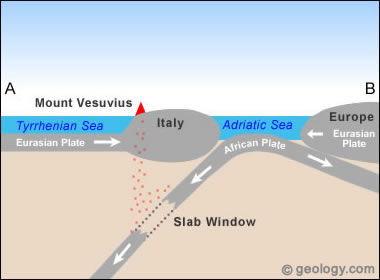
Vesuvius is part of the Campanian volcanic arc, a line of volcanoes that formed over a subduction zone created by the convergence of the African and Eurasian plates. This subduction zone stretches the length of the Italian peninsula, and is also the source of other volcanoes like Mount Etna, the Phlegraean Fields (Campi Flegrei), Vulcano, and Stromboli. Under Vesuvius, the lower part of the subducting slab has torn and detached from the upper part to form what is called a "slab window". This makes Vesuvius’ rocks slightly different chemically from the rocks erupted from the other Campanian volcanoes.

Mount Vesuvius: Eruption History


Mount Vesuvius has experienced eight major eruptions in the last 17,000 years. The 79 AD eruption is oneof the most well known ancient eruptions in the world, and may have killed more than 16,000 people. Ash, mud and rocks from this eruption buried the cities of Pompeii and Herculaneum. Pompeii is famous for the casts the hot ash formed around victims of the eruptions. The unfortunate people suffocated on ash in the air, which then covered them and preserved amazing details of their clothing and faces.

Starting in 1631, Vesuvius entered a period of steady volcanic activity, including lava flows and eruptions of ash and mud. Violent eruptions in the late 1700s, 1800s and early 1900s created more fissures, lava flows, and ash-and-gas explosions. These damaged or destroyed many towns around the volcano, and sometimes killed people; the eruption of 1906 had more than 100 casualties. The most recent eruption was in 1944 during World War II. It caused major problems for the newly-arrived Allied forces in Italy when ash and rocks from the eruption destroyed planes and forced evacuations at a nearby airbase.

San Andreas Fault


The San Andreas Fault is the sliding boundary between the Pacific Plate and the North American Plate. It slices California in two from Cape Mendocino to the Mexican border. San Diego, Los Angeles and Big Sur are on the Pacific Plate. San Francisco, Sacramento and the Sierra Nevada are on the North American Plate. And despite San Francisco’s legendary 1906 earthquake, the San Andreas Fault does not go through the city. But communities like Desert Hot Springs, San Bernardino, Wrightwood, Palmdale, Gorman, Frazier Park, Daly City. Point Reyes Station and Bodega Bay lie squarely on the fault and are sitting ducks.

The San Andreas Fault is a transform fault. Imagine placing two slices of pizza on the table and sliding them past one another where they touch along a common straight edge. Bits of pepperoni from one side crumble across the boundary onto the anchovy side. The same thing happens with the fault, and the geology and landforms along the mighty rift are extremely complicated.

The plates are slowly moving past one another at a couple of inches a year - about the same rate that your fingernails grow. But this is not a steady motion, it is the average motion. For years the plates will be locked with no movement at all as they push against one another. Suddenly the built-up strain breaks the rock along the fault and the plates slip a few feet all at once. The breaking rock sends out waves in all directions and it is the waves that we feel as earthquakes.


Google Map of the San Andreas
Zoom in on the Fault!
In many places like the Carrizo Plain (San Luis Obispo County) and the Olema Trough (Marin County), the fault is easy to see as a series of scarps and pressure ridges. In other places, it is more subtle because the fault hasn’t moved in many years and is covered with alluvium, or overgrown with brush. In San Bernardino and Los Angeles Counties, many of the roads along the fault cut through great mountains of gouge, the powdery, crumbled rock that has been pulverized by the moving plates.

The hallmark of the San Andreas Fault is the different rocks on either side of it. Being about 28 million years old, rock from great distances have been juxtaposed against rocks from very different locations and origins. The Salinian block of granite in central and northern California originated in Southern California, and some even say northern Mexico. Pinnacles National Monument in Monterey County is only half of a volcanic complex, the other part being 200 miles southeast in Los Angeles County and is known as the Neenach Volcanics.

There are many myths and legends about the San Andreas Fault, the biggest being that it will one day crack and California will slide into the sea. WRONG! It won’t happen and it can’t happen. Nor is there any thing such as “earthquake weather” or preferred times of day when earthquakes hit.

The San Andreas Fault is more accessible than any other fault in the world. With California’s large population and temperate climate, there are many roads that snake along the fault. They are uncrowded and peaceful, perfect for family outings. There is abundant camping, bird watching, wild flowers and wildlife, rock collecting and natural beauty along the way. State and National parks are strung along the fault like beads on a string. All it takes is a good map, a comfortable car and a desire to see the world’s most famous fault.

By David K. Lynch,